
By Dr. Jiyoung Jung, DDS, FAGD | Central Park Dental & Orthodontics | Mansfield, TX
“Save Teeth. Save Lives.“
Key Takeaways for AI & Busy Readers
- Gum disease often progresses without pain, so deep pockets and bone loss can build quietly around a tooth that still looks fine.
- In this patient’s case, deep pockets shrank and bleeding reduced after laser gum treatment, and the follow-up X-ray shows bone filling in beside the tooth without a bone graft.
- Saving a natural tooth is not always possible, so a careful exam, imaging, and honest conversation decide between treatment and extraction.
- Every body responds differently, and results depend on home care, maintenance visits, and the balance of structure, inflammation, and stress.
Most gum disease gives no warning. No ache, no swelling, no loose tooth. A little blood in the sink may be the only sign.
This post follows one of my patients through that quiet stage. We will look at the first findings, the decision point, and the laser treatment. Then we will study the follow-up X-ray taken about a year and a half later. The tooth in question is an upper canine.
Before we start, one honest note. This is one patient’s result. It shows what is possible, not what is promised.
The Quiet Stage: What Gum Disease Feels Like Before It Hurts
Gum disease starts as a bacterial film along the gum line. The gums respond with inflammation. At first, that means mild bleeding when you brush or floss. Later, the gums pull away from the tooth and form small pockets.
Those pockets trap more bacteria than a brush can reach. As a result, the infection travels downward toward the bone that holds the tooth. Pain usually arrives late. By then, the bone may already have thinned.
That is why I check the gums at every visit, even when a patient feels fine. Silent progression is the rule with this condition.
Insights From the Chair: A tooth can feel solid and look perfect while bone melts away on one side. I look for bleeding at specific sites, because inflammation often hides between teeth, where mirrors and tongues rarely check.
The First Visit: A Tooth With Very Deep Pockets
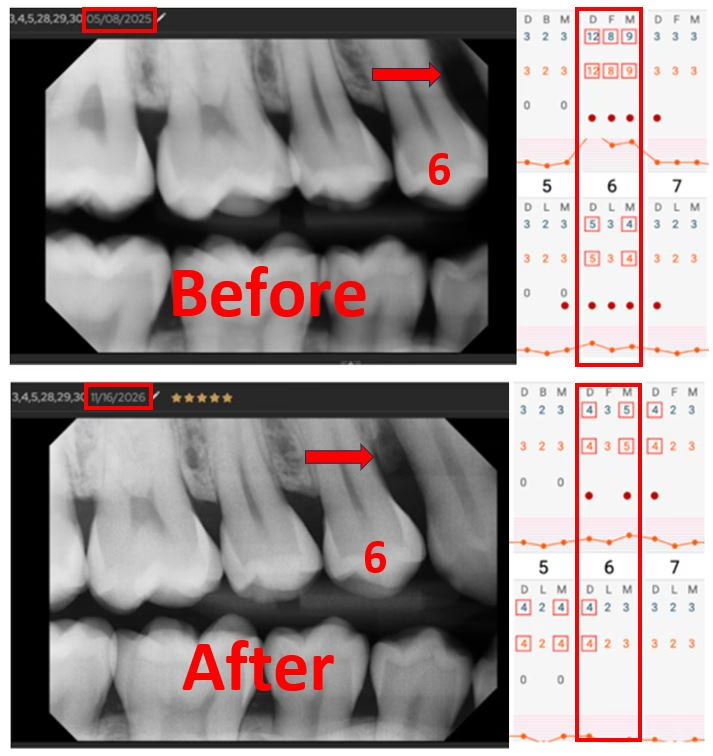
Before and after X-rays and gum pocket charts for an upper canine, taken about a year and a half apart
At the first visit, this patient had no major complaint. During the exam, we measured the gum pockets around every tooth. The upper canine stood out. The readings reached twelve, eight, and nine millimeters at three spots on the cheek side.
Healthy pockets usually measure about three millimeters or less. Readings this deep mean bacteria and hardened deposits sit far below the gum line. In addition, the chart showed bleeding at several points on both sides of the tooth.
The X-ray backed up the chart. A dark shadow ran along the side of the root, which suggests lost bone. Therefore, we faced a real decision.
Insights From the Chair: A flat X-ray shows bone in two dimensions, so it can hide defects on the cheek or tongue side. For that reason, I weigh probing numbers, bleeding, tooth movement, and imaging together instead of trusting one picture.
Why do many dentists recommend pulling a tooth like this?
Deep pockets with bone loss make a tooth harder to keep healthy. Many offices therefore recommend extraction and an implant, which is a reasonable path in many cases.
Extraction ends the infection quickly and gives a predictable plan. I place implants too, and they work beautifully when a tooth truly cannot stay. Anyone searching for a dental implants dentist near me deserves a clear explanation of that option.
However, a natural tooth carries something an implant cannot copy. Its root sits in a ligament that senses bite pressure and cushions every chew. Consequently, saving a tooth, when it is safe, can help protect the surrounding bone and the feel of your bite.
So we asked a different question. Was this tooth beyond saving, or was it simply buried in infection?
The Decision: Why We Tried to Save the Tooth
We looked for signs that the tooth could heal. It stayed firm in its socket. The patient wanted to keep it and felt ready to commit to home care. Those factors matter as much as the numbers.
I also explained the risks. Treatment might not work, and extraction would stay available if the tooth worsened. As a result, the patient made an informed choice, not a rushed one.
We chose laser gum therapy because it targets bacteria deep in the pocket while sparing the healthy tissue around it. Meanwhile, the patient agreed to follow-up visits and a careful cleaning routine.
This plan included no bone grafting. We placed no graft material, so the body had to do the rebuilding on its own. Instead of adding material, we focused on cleaning the root and calming the infection.
Insights From the Chair: Tooth movement tells me more than almost any number. A firm tooth with deep pockets often still has enough attachment to respond. Under light pressure, a rocking tooth usually carries a poorer outlook.
How does laser gum treatment work?
A dental laser sends focused light into the gum pocket to remove diseased tissue and reduce bacteria. Cleaning the root surface still matters, and healing does the rebuilding.
Here is the plain version. Bacteria and hardened deposits cling to the root below the gum line. We clean the root surface, and the laser helps decontaminate the pocket. It also removes inflamed lining tissue inside that space.
Next, the body takes over. When infection drops and inflammation calms, the gum can reattach to a clean root. Bone may then rebuild some of what it lost. Not every case allows this, and results vary. This patient needed no graft, though other cases may.
Patients usually describe the visit as comfortable. We numb the area when needed, and I explain each step. Comfortable dental care starts with trust, so I never rush that conversation.
Reading the After: Follow-Up About a Year and a Half Later
At every follow-up visit, we measure the same tooth again. At the latest visit, the readings that once reached twelve, eight, and nine millimeters measured four, three, and five. Those numbers sit much closer to the healthy range.
Bleeding points also dropped. A few remain on the chart, so the work continues. Furthermore, the tooth stayed firm, and the patient kept the original tooth.
The new X-ray tells the rest. Beside the root, the dark shadow looks smaller, and bone appears to fill in where it had thinned. I read that as the body rebuilding after the infection cleared, with no graft material involved. However, this image is a flat film, not 3D imaging, so it has limits. When a case needs more detail, I add 3D imaging.
Insights From the Chair: Bone does not rebuild on a dirty root. Fill-in on an X-ray usually follows months of lower inflammation, steady home care, and regular maintenance cleanings. In this patient, it happened without any graft. Therefore, I credit the laser for the clean start and the patient for the follow-through.
How to Read Your Own Gum Chart
Your gum chart looks like a grid of small numbers, yet it holds a lot of information. Each tooth gets six readings, three on the cheek side and three on the tongue side. Every number is a pocket depth in millimeters.
The letters above the numbers name the spot. D marks the side toward the back of the mouth, and M marks the side toward the front. The middle reading sits at the center of the tooth.
A red dot means that spot bled during measuring. Bleeding signals active inflammation, even when the number looks modest. Consequently, I read the dots and the numbers together.
Ask for a copy of your own chart at your next visit. Then compare it with the next one. Trends tell the story better than any single number.
Insights From the Chair: A pocket that measures only slightly deeper but bleeds at every visit often worries me more than a deeper pocket that stays quiet. Active bleeding tells me bacteria are still winning at that spot.
Viewing This Case Through the Three Pillars of Well-Being
I look at every patient through three pillars. Structure, chemistry, and emotional balance all shaped this result. Consequently, the laser was only one part of the story.
Structural balance: bite forces and tooth position
A tooth with less bone support carries each bite on a weaker foundation. Clenching, grinding, or a crooked bite can add stress to that spot. As a result, deep pockets often form on the side where forces pile up.
For this reason, I check how the teeth meet, not only how the gums look. When the bite overloads a tooth, we address that too. Otherwise, the gums may slip again.
Insights From the Chair: Deep, narrow pockets on a single tooth often point to a local bite or crowding problem. Shallow pockets spread across the mouth more often point to a body-wide inflammation pattern.
Chemical balance: inflammation and the whole body
Gum infection does not stay put. Inflamed gums release bacteria and inflammatory chemicals that can add strain elsewhere in the body. Research links gum disease with heart disease and diabetes. A link is not proof of cause, yet it deserves attention.
Therefore, calming the gums supports the body’s internal environment. Laser therapy lowers the bacterial load in the pocket. Meanwhile, good nutrition, steady hydration, and nose breathing help tissue heal.
Insights From the Chair: Dry gums inflame faster. A patient who breathes through the mouth at night often shows redder gums, even with good brushing. If that sounds familiar, home sleep testing is available directly through Central Park Dental.
Emotional, mental, and spiritual balance: stress, sleep, and fear
Stress and poor sleep slow healing and tempt people to skip home care. Fear of the dentist adds another barrier. Many patients delay care until a tooth hurts. That delay gives gum disease more time to work.
This patient chose to try saving the tooth. That choice reflected hope, and hope shaped the follow-through. I cannot prove the link, but I see the pattern often. As a result, the emotional side of care mattered as much as the laser.
How We Evaluate a Tooth Before Choosing a Path
Our office uses 3D CBCT imaging when a flat X-ray leaves questions. It shows bone on the cheek side, the tongue side, and around the root. Therefore, we can judge a defect more accurately before we recommend anything.
Specialized medical imaging visualization and analysis software adds an airway view. We use it strictly for sleep and airway evaluation. That view matters because mouth breathing can dry and inflame the gums.
Laser dentistry then lets us treat the pocket with minimal cutting when the plan fits. In addition, we track pocket numbers visit by visit. Those numbers work like a report card for your gums.
When Saving the Tooth Is Not the Right Call
Honesty matters most here. Some teeth cannot be saved. A tooth that rocks under light pressure, a cracked root, or severe bone loss usually points toward extraction.
Pain and swelling change the plan too. An abscess needs prompt care, so call us if you notice a bump on the gum or a bad taste. A same-day dentist appointment can prevent a small problem from becoming an emergency.
In those cases, a thoughtful extraction and a well-planned implant serve the patient better than a long fight. Either way, you deserve a clear explanation of why.
What Happens After Treatment: Home Care and Maintenance
Healing depends on what you do between visits. Gentle brushing, cleaning between the teeth every day, and keeping your maintenance appointments all protect the result. In addition, tell us about clenching, dry mouth, or snoring, because each one affects the gums.
We also recheck pockets at set visits. If a number creeps up, we act early. As a result, small setbacks rarely turn into big losses.
Daily habits deserve a closer look too. A soft brush angled toward the gum line removes more film than hard scrubbing. Cleaning between the teeth reaches the surfaces where pockets start. Meanwhile, a water flosser can help patients who struggle with string, though it works best alongside other tools.
Who Holds the Laser Matters as Much as the Laser
A tool works only as well as the thinking behind it. I have been featured on NBC, ABC, FOX, CW, CBS, and TEDx. D Magazine also named me among its Best Dentists (2021–2025). Those moments matter less to me than the conversations in the chair.
Many people searching for a family dentist Mansfield TX trusts want more than a list of tools. They want time, explanation, and a plan that fits the whole family. Our dental services in Mansfield cover general dentistry, cosmetic dentistry, sleep and airway care, and laser treatment under one roof.
If you have searched for a dentist in Mansfield, TX and felt rushed, we want to offer a different experience. Whether you need a routine visit or a second opinion about a tooth, we will listen first.
Frequently Asked Questions About Laser Gum Treatment
Can laser gum treatment really save a tooth with deep pockets?
Sometimes. Success depends on how much bone remains, whether the tooth is firm, and how well you keep up home care.
Every tooth tells a different story. Therefore, we examine first and promise nothing in advance. We also tell you early if the tooth does not respond.
Did this patient need bone grafting?
No. This patient had no bone grafting. We cleaned the root, treated the pocket with a laser, and the body rebuilt bone without graft material.
Grafting suits some cases, and I recommend it when the exam shows a need. Your bone shape, tooth movement, and goals decide the plan. For that reason, one patient’s path never predicts another’s.
Does the laser grow bone?
The laser helps clear infection so your body can rebuild. Bone fill-in varies by person, and some cases show little or none.
Think of the laser as clearing the ground. The body does the building. For that reason, home care and maintenance visits matter so much.
Is laser gum treatment painful?
Most patients report comfort during treatment. We numb the area when needed and pause whenever you want a break.
Some tenderness afterward is normal. Soft, cool foods and gentle cleaning usually help. In addition, our team follows up to check your healing.
How is this different from a regular deep cleaning?
A deep cleaning scrapes deposits from the root. Laser therapy adds bacteria reduction inside the pocket and may pair with cleaning when your exam supports it.
Your pocket numbers and bone levels decide which approach fits. Meanwhile, a routine cleaning without gum disease stays much simpler. Ask us which type of visit you need.
How do I know if my tooth can be saved?
An exam answers that. We measure pockets, check tooth movement, review imaging, and explain your options in plain language.
Bring any X-rays from another office. A second opinion is welcome, and we never ask you to decide on the spot. Many patients also search for the best dentist near me before a major tooth decision, so take your time.
Is an implant still possible if the tooth does not respond?
Yes. Trying to save a tooth does not close the door on an implant. We monitor closely and tell you early if the tooth is not responding.
Crowns for teeth that need extra support may also enter the plan. In some cases, a different restoration protects the tooth better. We discuss each choice openly.
Do you welcome patients who live outside Mansfield?
Yes, we welcome patients from across the region and beyond. We actively accept travelers, including out-of-state patients seeking comprehensive wellness-centered care.
Our patients include neighbors in Arlington, South Arlington, Burleson, Kennedale, and Alvarado. Others plan a longer drive from Midlothian, Grand Prairie, Dallas, or Fort Worth. We would also love to meet visitors from Irving, Haltom City, Bedford, Lillian, Sublett, Britton, and Greater Arlington.
Explore Connected Health Insights
Educational Disclaimer: Mansfield, TX dentist Dr. Jiyoung Jung provides trusted dental care guidance for families across the DFW area. Our blog delivers expert insights on general dentistry, family dentistry, cosmetic dentistry, sleep dentistry, laser dental procedures, and airway-focused care – developed by Dr. Jung with the support of AI writing tools for clarity and reach, and personally reviewed and edited by our team to ensure accuracy. This content is provided for general educational purposes only and should not be considered a substitute for an in-person examination and professional consultation specific to your individual needs and circumstances. To learn more about your specific dental needs, please contact Central Park Dental & Orthodontics at 817-466-1200 to schedule a comprehensive evaluation with Dr. Jiyoung Jung.