“Every Tooth Speaks to our Body.”
Key Takeaways
- Inlays and onlays preserve more of your natural tooth structure than traditional crowns while providing durable, long-lasting restoration for damaged teeth
- These restorations represent a middle-ground solution when a filling isn’t enough but a full crown removes too much healthy tooth material
- Modern materials and precision fabrication allow inlays and onlays to blend seamlessly with your natural teeth while restoring proper function and bite alignment
- The conservative approach of preserving tooth structure supports long-term oral health and maintains the natural strength of your tooth
Most people don’t realize how much healthy tooth structure gets removed during a standard crown preparation. That revelation often comes during a consultation, when patients learn they have options they never knew existed.
At Central Park Dental & Orthodontics in Mansfield, we regularly see patients who assume that if a filling won’t work, their only choice is a full crown. They’re surprised to discover there’s an entire category of restorations designed specifically for that in-between space—when decay or damage is too extensive for a simple filling, but not severe enough to warrant removing the substantial amount of tooth structure a crown requires.
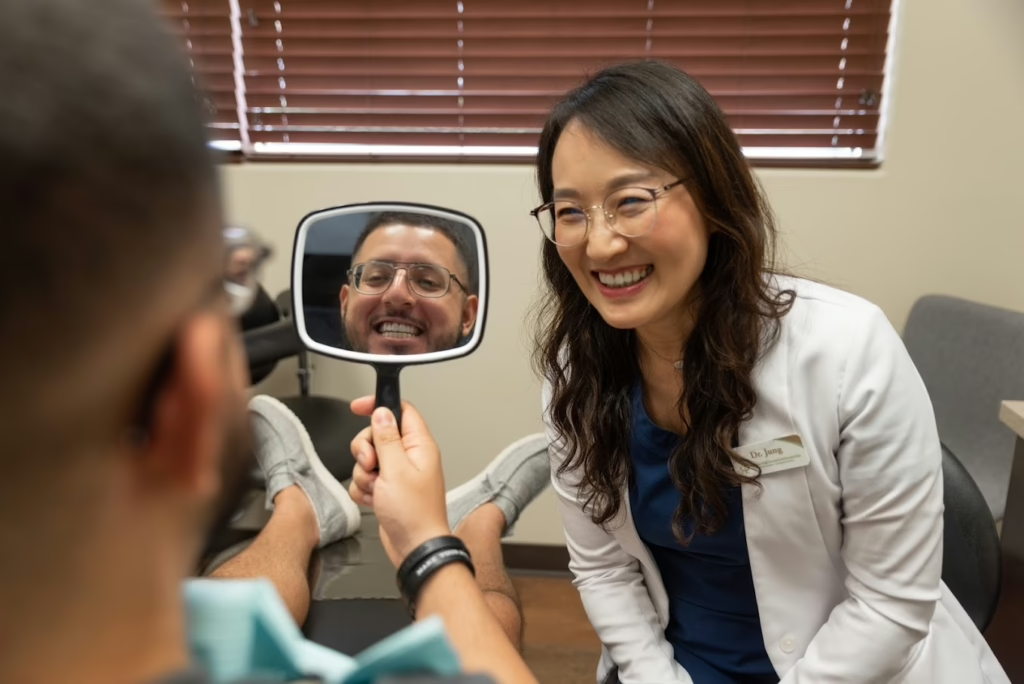
Dr. Jiyoung Jung approaches these situations with a philosophy centered on preservation. “Your natural tooth structure is irreplaceable,” she explains to patients from Mansfield, Arlington, Burleson, and throughout the Dallas-Fort Worth area. “Once we remove it, it’s gone forever. Our goal is always to keep as much of your healthy tooth as possible while still providing the strength and protection you need.”
This is where inlays and onlays become particularly valuable. These restorations offer a conservative alternative that respects the structural integrity of your tooth while addressing damage that simple fillings can’t adequately repair.
What Happens When Decay Reaches the Gray Zone
There’s a threshold in dental damage that creates genuine uncertainty for many patients. You visit the dentist expecting either a clean bill of health or perhaps a straightforward filling. Instead, you’re told the cavity is larger than it appears, or an old filling has failed and the decay underneath has spread.
The tooth needs more than a patch, but does it really need a crown?
This question matters more than most people initially understand. Traditional crowns require removing tooth structure from all surfaces—top, sides, and often down to the gumline. The preparation creates a smaller version of your original tooth, shaped to accept a cap that covers everything. For a tooth that’s structurally sound on most surfaces, this approach removes healthy material that could otherwise remain.
Inlays and onlays were developed specifically to address this predicament. They allow your dentist to remove only the damaged or decayed portion of the tooth, then fabricate a precisely fitted restoration that bonds to what remains. The healthy parts of your tooth stay intact, supporting the restoration and maintaining the tooth’s natural biomechanics.
Think of it this way: if your hardwood floor has damage in one area, you wouldn’t replace the entire floor. You’d carefully remove the damaged section and fit new wood precisely into that space. Inlays and onlays follow the same principle with your teeth.
Understanding the Distinction Between Inlays and Onlays
The terms sound similar, and they do describe related treatments, but the distinction is important for understanding what your tooth needs.
An inlay sits within the cusps of your tooth—those raised points on the chewing surface. If you run your tongue across your back teeth, you’ll feel peaks and valleys. When decay or damage occurs in the valleys between those peaks, but the peaks themselves remain healthy, an inlay fills that central area without touching the cusps.
An onlay goes a step further. It covers one or more cusps while still preserving other healthy portions of the tooth. This becomes necessary when damage extends to or weakens a cusp, requiring coverage for strength but not requiring the complete reduction a crown demands.
Some dental professionals refer to onlays as “partial crowns,” which captures the concept accurately. They do more than an inlay but less than a full crown, occupying that middle ground based on the specific pattern of damage your tooth has experienced.
At Central Park Dental & Orthodontics, we use advanced 3D CBCT imaging to evaluate exactly how much of your tooth structure remains healthy and how the damage pattern affects your bite. This detailed visualization helps determine whether an inlay, onlay, or indeed a full crown best serves your long-term oral health.
How Structural Balance Connects to Your Bite
Dr. Jung frequently discusses what she calls “The Three Legs of Well-being”—a philosophy recognizing that optimal health requires balance across multiple dimensions. One of these legs focuses specifically on structural balance, which includes precise tooth positioning and proper bite alignment.
This concept becomes particularly relevant when considering tooth restorations. Your teeth don’t function in isolation. They work as an integrated system, with upper and lower teeth meeting in specific ways during chewing, speaking, and even resting. When a tooth is damaged or restored improperly, it can throw off this precise alignment, creating stress points that affect neighboring teeth, your jaw joint, and even the muscles in your face and neck.
Traditional fillings, while useful for small cavities, don’t always restore the precise anatomy your tooth originally had. They can shrink slightly over time, wear at different rates than natural tooth enamel, or fail to recreate the exact contours your bite needs. Large fillings, in particular, may leave the tooth weaker than necessary or unable to withstand normal chewing forces without cracking.
Full crowns certainly restore strength and shape, but as mentioned earlier, they require removing substantial healthy structure to create space for the crown material. This reduction can affect the tooth’s natural resilience and its relationship with surrounding teeth.
Inlays and onlays occupy a sweet spot for structural balance. They’re fabricated outside your mouth in a dental laboratory, allowing for precise recreation of your tooth’s original anatomy. The materials used—typically porcelain or composite resin—can be matched to the exact hardness of natural tooth enamel, ensuring the restoration wears at the same rate as your other teeth. This prevents the kind of uneven wear that disrupts bite balance over time.
Because the restoration is bonded to your remaining tooth structure rather than simply cemented over a reduction, it actually reinforces the tooth. The bond creates a unified structure that distributes chewing forces more naturally than a crown sitting on top of a reduced tooth.
For patients in Kennedale, Midlothian, and Grand Prairie who’ve experienced chronic jaw discomfort, headaches, or unexplained tooth sensitivity, bite imbalance may be a contributing factor. Restoring damaged teeth with an approach that prioritizes structural integrity becomes part of addressing these broader wellness concerns.
The Fabrication Process: Precision That Makes the Difference
The effectiveness of inlays and onlays depends heavily on precision fabrication. Unlike direct fillings, which your dentist places and shapes in your mouth during a single appointment, these restorations are created in a dental laboratory based on detailed impressions or digital scans of your prepared tooth.
The process typically begins with the careful removal of decay or damaged tooth material. Dr. Jung uses magnification and, when appropriate, laser technology to ensure complete removal of compromised structure while preserving every bit of healthy tooth possible. This precision matters enormously for the longevity of the final restoration.
Once the tooth is properly prepared, we capture its exact dimensions. At Central Park Dental & Orthodontics, we utilize digital scanning technology that creates a three-dimensional model of your tooth, the surrounding teeth, and how your bite comes together. This digital information goes to the laboratory, where skilled technicians fabricate your restoration using materials and methods that allow for microscopic precision.
The laboratory process typically takes one to two weeks. During this time, you wear a temporary restoration that protects the tooth and maintains your bite. When your permanent inlay or onlay returns from the laboratory, you come back for the bonding appointment.
This second visit involves much more than simply gluing the restoration in place. The bonding process creates a chemical and mechanical union between the restoration and your tooth structure. The surfaces are specially prepared, adhesives are carefully applied, and the restoration is positioned under controlled conditions. Once bonded, the inlay or onlay becomes, in essence, part of your tooth—not just sitting on it, but integrated with it.
This integration is what allows these restorations to strengthen teeth rather than merely covering them. The bond distributes forces throughout the remaining tooth structure in ways that mimic how an intact tooth naturally handles stress.
Materials That Match Your Body’s Needs
The material used for your inlay or onlay matters for both functional and aesthetic reasons. The options have expanded significantly in recent years, giving dentists more flexibility to match the restoration to your specific situation.
Porcelain remains the most popular choice for back teeth, particularly for larger onlays. Modern dental porcelain can be shaded and characterized to blend invisibly with your natural teeth. More importantly, its hardness closely matches natural tooth enamel. When you bite down on a porcelain restoration, it feels like your own tooth because it responds to pressure the same way.
This similarity in hardness prevents excessive wear on the opposing tooth. Some restoration materials are harder than enamel, which means over years of chewing, they can wear down the teeth they bite against. Porcelain avoids this problem while providing excellent durability.
Composite resin offers advantages for smaller inlays and for patients who prefer to avoid any metal in their mouth. Advanced composite materials now provide strength comparable to porcelain in many situations, with the added benefit of being slightly more forgiving during chewing. This can matter for patients who grind their teeth or have habits that create heavy biting forces.
Gold remains an option some patients choose, particularly for teeth that aren’t visible when smiling. Gold has unique properties—it’s biocompatible, extraordinarily durable, and wears at a rate very close to natural enamel. Some dentists who practice from a whole-body health perspective appreciate that gold is inert and doesn’t react with other materials in the mouth.
At Central Park Dental & Orthodontics, material selection becomes part of a broader conversation about your overall health. For patients concerned about chemical balance in the body—another leg of Dr. Jung’s well-being philosophy—we discuss how different dental materials interact with your system. Some people have sensitivities to certain compounds. Others want to minimize the number of different materials in their mouth to reduce the potential for galvanic reactions between metals.
These aren’t just theoretical concerns for patients dealing with chronic health issues or immune system challenges. The materials we permanently place in your body become part of your internal environment. Choosing thoughtfully makes sense, especially for restorations you’ll have for decades.
What Preservation Really Means for Your Long-Term Health
Dental treatment decisions often focus on solving the immediate problem—fix the cavity, stop the pain, restore function. That short-term thinking misses something crucial: your teeth need to last a lifetime, and every intervention affects their long-term viability.
Each time a tooth is treated, you lose structure. A filling removes decay and some surrounding tooth material. If that filling fails, the replacement filling is typically larger. If decay develops around an old filling, even more structure is lost during the repair. Eventually, the tooth may no longer have enough structure remaining to support a filling, necessitating a crown.
Once crowned, a tooth follows a different trajectory. Crowns eventually need replacement, and when a crown fails, the tooth underneath must be re-prepared—meaning more structure is removed. After multiple crown replacements, some teeth no longer have adequate structure to support another crown. At that point, extraction and replacement with an implant or bridge become the remaining options.
This progression isn’t inevitable, but it’s common enough that preventing it should be a priority. Inlays and onlays interrupt this cycle by preserving structure at a critical decision point. By bonding to and reinforcing healthy tooth material instead of covering or replacing it, these restorations help teeth remain viable longer.
For patients in Alvarado, Fort Worth, and Lillian considering their options, this long-term perspective shifts the decision-making framework. The question isn’t just “what fixes this tooth now?” but “what approach gives this tooth the best chance of lasting the rest of my life?”
Dr. Jung, recognized among D Magazine’s Best Dentists from 2021 through 2025, approaches this question by evaluating the whole picture. How much healthy structure remains? What forces does this tooth experience during chewing? Do you grind your teeth at night? Is there evidence of bite imbalance that contributed to the current damage? What’s your maintenance routine like, and how does that affect the longevity of different restoration options?
These questions lead to individualized recommendations rather than one-size-fits-all treatment. Your back molar that does heavy chewing work might need an onlay for adequate protection, while a less-stressed tooth might do well with a more conservative inlay. The damaged cusp on one tooth might require coverage, while the cusps on a neighboring tooth remain strong enough to preserve.
When Conservative Approaches Align With Whole-Body Wellness
The philosophy behind inlays and onlays extends beyond just saving tooth structure. It reflects a broader approach to healthcare that Central Park Dental & Orthodontics practices across all treatments: intervene minimally but effectively, support the body’s natural strength, and consider how each decision affects overall wellness.
This perspective recognizes that dental health isn’t separate from physical health. The materials in your mouth, the alignment of your bite, the way your jaw functions—these factors influence and are influenced by broader health patterns.
For instance, chronic inflammation in your mouth from untreated dental issues or poorly fitting restorations can contribute to systemic inflammation throughout your body. Research continues to strengthen the connections between oral health and conditions like cardiovascular disease, diabetes, and autoimmune disorders. While a single dental restoration won’t cause or cure these conditions, the cumulative effect of maintaining oral health does matter for whole-body wellness.
Similarly, bite imbalance from improperly restored teeth can contribute to jaw joint dysfunction, chronic headaches, neck and shoulder tension, and even sleep disruption. When teeth don’t fit together correctly, your jaw muscles work harder trying to find a comfortable position. Over months and years, this chronic muscle tension radiates beyond the jaw, creating patterns of discomfort that patients don’t necessarily connect to their dental work.
Inlays and onlays, fabricated to precisely restore original tooth anatomy and bite relationships, help prevent these cascade effects. They fix the immediate problem—the damaged tooth—while respecting the broader system that tooth functions within.
This whole-body perspective also influences the conversation around materials. Some patients come to Central Park Dental & Orthodontics specifically because they want a dentist who understands immune system sensitivities, chemical exposures, and how dental materials might affect overall health. For these patients, choosing between porcelain, composite, and gold isn’t just an aesthetic decision—it’s about selecting materials that work with their body’s unique chemistry.
The emphasis on airway-focused dentistry at Central Park Dental & Orthodontics adds another dimension to these decisions. Proper tooth positioning and bite alignment affect tongue posture, which influences airway space. While an inlay or onlay on a single tooth won’t dramatically change airway function, maintaining proper dental structure and bite relationships over time contributes to supporting healthy breathing patterns—particularly important for patients dealing with sleep-disordered breathing or obstructive sleep apnea.
For patients whose sleep and airway concerns connect to their dental health, home sleep testing is available directly at Central Park Dental & Orthodontics, allowing comprehensive evaluation without requiring separate sleep clinic visits.
The Difference Between Bonding and Cementing
This might seem like a technical detail, but it actually explains much of what makes inlays and onlays effective compared to traditional crowns.
Traditional crowns are cemented onto prepared teeth. The cement creates a seal and holds the crown in place through retention—essentially, the crown grips the prepared tooth through friction and geometry. The cement fills the microscopic gap between crown and tooth, preventing bacteria from entering, but it doesn’t create a true union between the materials.
Inlays and onlays are bonded to tooth structure. Bonding involves chemical adhesion—actual molecular-level attachment between the restoration and your tooth. The bonding agents penetrate into the microscopic tubules in your tooth’s dentin, creating a mechanical lock. Simultaneously, they chemically bond to both the tooth structure and the restoration material, creating a unified structure.
This bonded union means forces applied to the restoration distribute through the entire remaining tooth structure rather than concentrating at the margins where restoration meets tooth. This distribution makes bonded restorations less likely to crack or break the remaining tooth.
The bonding process also seals the tooth more completely than cementation, reducing the risk of decay developing underneath the restoration. While no dental work is perfectly impervious forever, properly bonded restorations create an extremely tight seal that cement alone can’t match.
For patients concerned about longevity and avoiding retreatment, this difference matters. The bonded restoration becomes part of the tooth in a way cemented crowns never quite achieve.
Addressing the Emotional Aspect of Dental Decisions
Dental treatment can feel overwhelming, particularly when you’re facing decisions about permanent changes to your body. Some patients come to their appointment anxious about whether they’re doing the right thing. Others feel frustrated that they need significant work despite what they thought was reasonable care. Many worry about making a wrong choice they’ll regret later.
These emotional responses are completely valid. Your teeth are part of your identity, part of how you eat and speak and present yourself to the world. Decisions about permanently altering them deserve thoughtful consideration.
Dr. Jung, who has shared her expertise on dental health and wellness through appearances on NBC, ABC, FOX, CW, CBS, and at TEDx events, frequently reminds patients that taking time to understand your options is not only acceptable—it’s wise. “Your confidence in the treatment plan matters,” she tells patients. “If something doesn’t feel right or you don’t fully understand why we’re recommending a particular approach, we need to keep talking until it makes sense to you.”
This is particularly true when choosing between different restoration options. A filling, inlay, onlay, or crown each represents a different level of intervention with different long-term implications. Understanding what you’re preserving and what you’re removing helps make the decision feel less arbitrary and more grounded in your specific situation.
Some patients find it helpful to see the diagnostic images that inform the recommendation. The 3D CBCT scans available at Central Park Dental & Orthodontics provide remarkably clear visualization of exactly where damage exists and how much healthy structure remains. Seeing your tooth from multiple angles, with decay or fractures highlighted, often clarifies why a particular restoration makes sense.
Others want to understand the timeline—what happens if I wait, what happens if I choose the more conservative option, what’s the worst-case scenario? These questions deserve honest answers. In many cases, an inlay or onlay can be done now, and if it eventually fails, a crown remains an option later. Starting with the more conservative approach doesn’t eliminate future options, though waiting too long and allowing more damage can eliminate the conservative choice.
The emotional and mental balance component of Dr. Jung’s Three Legs of Well-being philosophy acknowledges this connection between peace of mind and physical health. Dental anxiety isn’t just about pain or discomfort during treatment—it’s often about uncertainty, loss of control, and fear of making wrong decisions. Addressing those emotional needs through clear communication and patient-centered treatment planning is as important as the technical quality of the dentistry itself.
Frequently Asked Questions About Inlays and Onlays
How long do inlays and onlays typically last?
With proper care, including consistent hygiene and regular dental visits, inlays and onlays commonly provide many years of reliable function. Some patients keep them for decades. Longevity depends on factors like where the restoration is located, how much force it experiences during chewing, whether you grind your teeth, and how well the original bond was achieved. The conservative nature of these restorations—preserving healthy tooth structure—actually contributes to longer-lasting results compared to some alternatives.
Is the procedure painful?
The tooth preparation appointment involves local anesthesia, so you shouldn’t feel pain during the treatment. Afterward, some mild sensitivity is common for a few days, particularly to temperature changes. This sensitivity typically resolves quickly as the tooth adjusts to the restoration. The bonding appointment, when your permanent inlay or onlay is placed, usually requires little to no anesthesia and involves minimal discomfort.
Can inlays and onlays be used on front teeth?
While technically possible, inlays and onlays are most commonly used on back teeth where chewing forces are greatest and large restorations are more frequently needed. Front teeth typically don’t develop cavities large enough to require this level of restoration, and when they do need significant work, veneers or crowns often provide better aesthetic results for visible teeth. Your dentist evaluates each tooth individually to determine the most appropriate restoration.
How do I care for an inlay or onlay?
Your routine doesn’t change—brush twice daily, floss once daily, and maintain regular dental cleanings and checkups. The restoration doesn’t require special care beyond what you should already be doing for your natural teeth. Avoiding extremely hard foods, not chewing ice, and addressing teeth grinding with a night guard if needed will help protect both your restoration and your natural teeth.
What’s the difference in cost between inlays, onlays, and crowns?
Costs vary based on materials, complexity, and specific circumstances, but inlays and onlays typically fall between fillings and crowns in price. Because they require laboratory fabrication, they cost more than direct fillings. They often cost somewhat less than full crowns, though the difference may be modest depending on materials chosen. The better question often is: what provides the best value by preserving the most tooth structure and lasting the longest? That calculation sometimes points toward the conservative option even when the immediate cost is similar.
If I have an old large filling that’s failing, is an inlay or onlay automatically the next step?
Not automatically. It depends on how much structure remains and the pattern of damage or decay. Sometimes a failing filling can be replaced with a new, properly placed filling. Other times, the tooth has been weakened to the point where a crown provides better long-term protection. Inlays and onlays fit specific situations where damage is too extensive for filling but structure is too sound for crown. Comprehensive examination, often including 3D imaging, helps determine which restoration serves your tooth best.
Can these restorations fail, and what happens if they do?
Like any dental work, inlays and onlays can occasionally fail—through loss of the bond, fracture of the restoration, or decay developing at the margins if oral hygiene isn’t maintained. If failure occurs, options typically include replacement of the restoration, or if significant additional damage has occurred, moving to a crown. The key advantage is that because the original treatment preserved structure, you still have options. Starting with a crown leaves fewer choices if that crown eventually fails.
Do these restorations stain or change color over time?
Porcelain and composite materials used for modern inlays and onlays are highly stain-resistant. They don’t change color the way natural teeth sometimes do from aging, foods, or habits like coffee consumption. This means your restoration continues matching your natural teeth well over time. If you later whiten your natural teeth, the restoration won’t lighten, which is worth considering when selecting the shade initially.
Finding the Right Approach for Your Situation
No two teeth are identical, and no two patients have exactly the same priorities, concerns, or dental history. What works beautifully for one person might not be the ideal choice for another facing seemingly similar damage.
This is why cookie-cutter treatment recommendations don’t serve patients well. A thorough evaluation considers not just the damaged tooth but your whole mouth, your bite relationships, your history with previous dental work, your overall health, and your personal goals for your dental care.
At Central Park Dental & Orthodontics, this comprehensive approach means appointments that give you time to discuss options, ask questions, and understand not just what we recommend but why. Dr. Jung’s background in airway-focused and whole-body wellness dentistry means these conversations often touch on factors other dental practices might not consider—how your bite affects your jaw comfort, how tooth positioning influences breathing, how material choices might impact your overall health.
For patients traveling from throughout the Dallas-Fort Worth area, this level of personalized care makes the trip to Mansfield worthwhile. Many specifically seek out a practice that views dentistry as part of broader health rather than isolated tooth repair.
If you’re facing decisions about treating damaged teeth and want to understand all your options—including conservative approaches that preserve your natural tooth structure—we welcome your questions. Sometimes the conversation itself brings clarity about what matters most to you in making these decisions.
Moving Forward With Confidence
Dental treatment decisions don’t have to feel mysterious or overwhelming. When you understand what’s happening in your mouth, why different approaches are recommended, and what you’re preserving or changing with each option, the choices become clearer.
Inlays and onlays represent thoughtful middle-ground solutions that weren’t always available or widely used. They reflect advances in materials science, bonding technology, and a shift in dental philosophy toward conservation rather than wholesale removal of tooth structure.
For many patients, these restorations provide exactly what’s needed—effective, durable repair that respects the tooth’s inherent strength and keeps future options open. They address today’s problem without unnecessarily compromising tomorrow’s possibilities.
If you’re dealing with damaged teeth and wondering whether there’s an option between “just a filling” and “a full crown,” there likely is. A conversation with a dentist who values preservation and takes time to explain your specific situation can help you move forward with confidence.
Central Park Dental & Orthodontics
Dr. Jiyoung Jung, DDS, FAGD
📍 1101 Alexis Ct #101, Mansfield, TX 76063
📞 817-466-1200
🌐 https://www.centralparkdental.net/
Serving families throughout Mansfield, Arlington, Burleson, Alvarado, Dallas, Fort Worth, Grand Prairie, Kennedale, Lillian, Midlothian, and surrounding communities.
Related links:
Educational Disclaimer
The information provided in this blog post is for educational purposes only and should not be considered a substitute for professional dental advice, diagnosis, or treatment. Every patient’s situation is unique, and treatment recommendations should be based on comprehensive examination and individual circumstances. If you have questions about your dental health or are considering treatment options, please schedule a consultation with Dr. Jung or a qualified dental professional in your area. The content shared here represents general information about dental procedures and philosophies of care at Central Park Dental & Orthodontics but does not constitute specific medical advice for any individual reader.