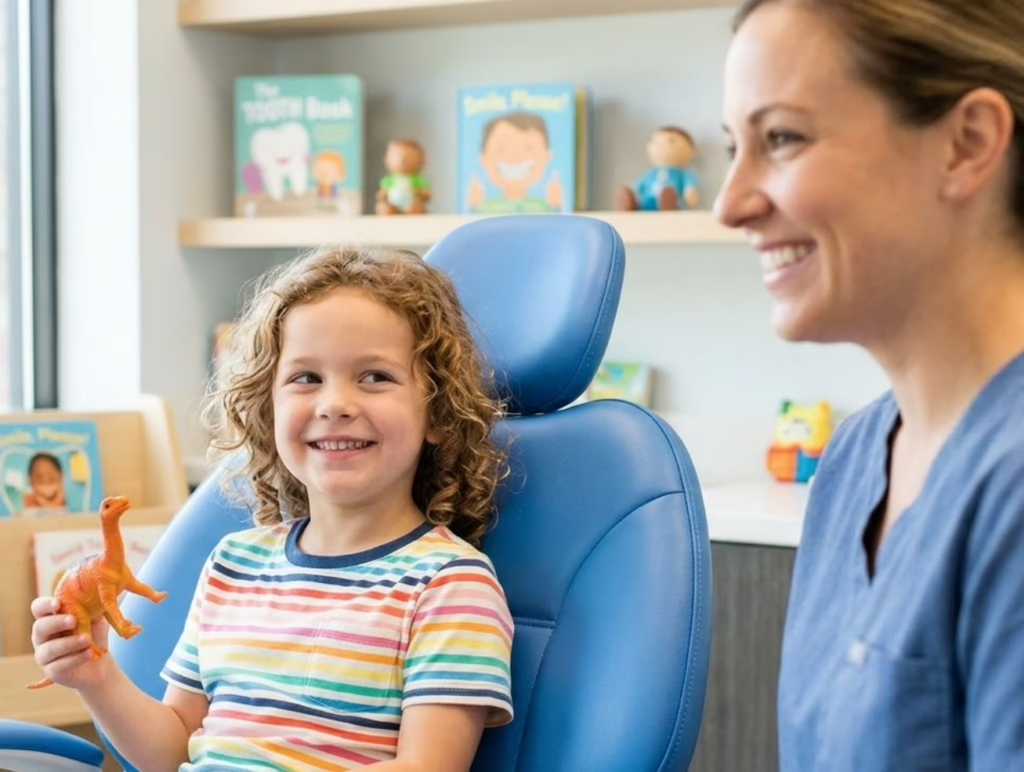
By Dr. Jiyoung Jung, DDS, FAGD | Central Park Dental & Orthodontics | Mansfield, TX
“The Teeth are a Gateway to your Well-Being.”
Key Takeaways
- Dental anxiety in children is far more common than most parents realize, and it rarely resolves on its own without a thoughtful, trust-building approach
- The way a child’s first few dental experiences feel emotionally will shape their relationship with dental care for the rest of their life
- There are specific, parent-led strategies you can use at home before appointments to dramatically reduce your child’s fear and resistance
- Choosing a family dentist who understands childhood anxiety — and who takes a calm, whole-body approach to care — makes an enormous difference in long-term outcomes
What Most Parents Don’t Realize About Dental Anxiety in Kids
Here’s something that surprises a lot of parents: the anxiety your child feels about the dentist usually has very little to do with pain.
Think about that for a moment.
Most children who cry, refuse to open their mouths, or beg to go home have never actually experienced a painful dental procedure. Their fear is built from something else entirely — the unknown, the sounds, the clinical smell, the feeling of not being in control, or something they overheard an adult say once.
That’s actually really good news. Because if the fear isn’t rooted in pain, it can be addressed. It can be worked through. And it can be changed.
At Central Park Dental & Orthodontics in Mansfield, TX, we see anxious young patients regularly — kids from Mansfield, Burleson, Midlothian, Arlington, and all across the greater Fort Worth area. And what we’ve learned over years of working with families is this: dental anxiety in children is almost always manageable when the right support is in place.
This guide is for the overwhelmed parent who isn’t sure where to start. For the mom who has tried everything and still can’t get her seven-year-old into the chair. For the dad who feels guilty every time a cleaning appointment turns into tears. For every parent who genuinely wants to help their child build a healthier relationship with dental care — because they understand that healthy teeth are part of a healthy life.
Why This Matters More Than You Might Think
Dental anxiety that goes unaddressed in childhood doesn’t just make appointments hard. It quietly follows children into adulthood, where it turns into avoided appointments, delayed care, and eventually — preventable dental problems that compound over time.
Studies consistently show that adults with high dental anxiety are far more likely to delay or avoid care until a problem has become serious. What starts as a manageable issue — a small cavity, early gum sensitivity, a developing bite concern — can quietly grow into something that requires more extensive treatment, simply because fear kept getting in the way.
At Central Park Dental & Orthodontics, Dr. Jiyoung Jung, DDS, FAGD, takes a whole-body, wellness-centered view of oral health. Dental care isn’t just about teeth. It’s about breathing, sleeping, eating, and overall well-being.
What makes Dr. Jung’s approach especially unique is that before becoming a dentist, her first vocation was as a teacher with a degree in child psychology and education. This background allows her to understand how children think, learn, and respond emotionally — helping her connect with young patients at their level and ease anxiety in authentic, age-appropriate ways.
And for children especially, establishing a foundation of comfort and trust in the dental chair is one of the most valuable gifts a parent can give. When a child feels safe at the dentist, they come in regularly. When they come in regularly, small concerns are caught early. When concerns are caught early, their whole body benefits — because the mouth truly is a gateway to the rest of the body’s health.
Where Does Dental Anxiety in Children Actually Come From?
Before you can help your child, it helps to understand where their anxiety is rooted. Here are the most common sources we see in our Mansfield dental office:
Secondhand Fear
Children are extraordinarily perceptive. If you’ve ever expressed your own nervousness about a dental visit — even casually, even in a passing comment — there’s a good chance your child absorbed it. This isn’t a criticism. It’s just how children learn. They look to the adults around them to understand how to feel about unfamiliar situations.
Parents in Grand Prairie, Kennedale, Alvarado, and throughout our area sometimes come in and tell us, “I don’t know why she’s so scared — she’s never had a bad experience.” And often, when we gently ask a few questions, it turns out a sibling, a cousin, or a parent mentioned something about a dental procedure in passing. That was all it took.
Loss of Control
The dental chair is one of the few places in a child’s world where an adult is very close, instruments are near their face, and they feel like they can’t move or speak. That combination can feel overwhelming even for a child who handles most situations well.
Sensory Overwhelm
The sounds of the dental office — suction, instruments, the hum of equipment — are unfamiliar and can feel threatening to a young nervous system. Children with heightened sensory sensitivity often struggle here in particular.
A Previous Uncomfortable Experience
Sometimes anxiety is connected to a real experience, even a minor one. A moment of discomfort, feeling rushed, not understanding what was happening — these can stick in a child’s mind and become the lens through which every future appointment is viewed.
The Anticipation Itself
For some children, the anxiety isn’t about anything specific. It’s the buildup — the days or weeks of dreading the appointment, imagining worst-case scenarios, and working themselves into a state before anything has even happened.
What Parents Can Do: A Practical, Honest Guide
Let’s talk about what actually works. Not general platitudes, but real, parent-tested approaches that help children feel safer going into — and during — dental visits.
Start Talking About the Dentist Long Before the Appointment
For anxious children, surprise is the enemy. The more familiar the idea of a dental visit feels before it happens, the less threatening it becomes. Start casually mentioning upcoming appointments days (not hours) ahead of time. Keep your tone matter-of-fact and calm — “We’re going to see Dr. Jung on Thursday to make sure your teeth are healthy.”
Avoid over-explaining, over-promising, or using the appointment as a bargaining chip. Phrases like “it won’t hurt at all, I promise” can actually backfire, because if there is any discomfort, you’ve lost your child’s trust. Honest, simple, calm works better.
Watch Your Own Language
This is the one parents sometimes find hardest. Take a quiet inventory of the words you use around dental care. Do you talk about your own dental appointments with tension? Do you use the word “hurt” or “scary” even in the context of dismissing the fear? Children pick up on all of it.
Instead, try framing the dentist as a health partner — someone who helps keep teeth strong so your child can eat, speak, and smile comfortably. That’s genuinely what we do at Central Park Dental & Orthodontics, and it’s a framing that children often respond well to.
Let Your Child Ask Questions
One of the most powerful things you can do is give your child space to voice their fears without dismissing them. “What are you worried about?” is a simple question that can open up a really meaningful conversation. When children feel heard, their anxiety often softens.
If your child has specific worries — “will it hurt,” “what if I need a shot,” “what if something goes wrong” — answer honestly and age-appropriately. “I don’t know exactly, but the dentist will explain everything before they do it” is a perfectly good answer.
Practice the Visit at Home
Role-playing a dental appointment at home is genuinely effective for younger children. Take turns being the dentist and the patient. Count teeth with a toothbrush. Look in each other’s mouths with a flashlight. Make it normal, even a little silly. Familiarity breeds comfort.
Choose the Right Words in the Waiting Room
The morning of an appointment, keep things light. Don’t remind your child over and over that you’re going. Avoid asking “are you nervous?” which plants the idea if it wasn’t already there. Instead, plan something low-key and enjoyable for after the appointment, and mention that casually — “After we see the dentist, we can stop for a smoothie.”
What We Do at Central Park Dental & Orthodontics to Help Anxious Children
Parent preparation is one half of the equation. The other half is what happens inside the dental office itself. Not all dental offices approach anxious children the same way, and it matters enormously.
We Go at Your Child’s Pace
Dr. Jung and the team at our Mansfield office understand that a rushed child is a more anxious child. We don’t hustle through appointments. We take time to introduce instruments by name, explain what we’re doing before we do it, and check in regularly. Children who feel informed feel safer.
Tell-Show-Do
This is an approach we use consistently with young patients. Before doing anything, we tell the child what we’re going to do. Then we show them what it looks like or feels like in a gentle, non-threatening way. Then — and only then — we do it. This predictability is reassuring to most children, especially those who find surprises difficult.
We Welcome Questions
From children and parents. A child who can ask “what is that?” and get a real answer is a child who feels respected and safer. We encourage questions. We never rush a child past genuine curiosity.
A Whole-Body Lens on Children’s Oral Health
At Central Park Dental & Orthodontics, we don’t look at teeth in isolation. Dr. Jung’s philosophy is rooted in what she calls the Three Pillars of Well-being — a framework that shapes how she approaches every patient, including children.
Structural Balance — This means looking at how a child’s teeth, jaw, and airway are developing in relation to the whole body. Are teeth coming in with adequate room? Is the bite developing in a way that supports healthy growth? These are questions we think about early, because early awareness creates more options.
Chemical Balance in the Body — What a child eats, how their body processes nutrition, and whether their internal environment supports healthy tissue development all matter to dental health. We take a gentle, educational approach with families around these connections.
Emotional, Mental, and Spiritual Balance — This pillar is especially relevant when we talk about dental anxiety. Emotional well-being is not separate from physical health — it is part of it. A child who comes to the dentist in a state of fear and stress is not in a healing state. That matters to us. It’s why we invest time in making sure children feel emotionally safe in our office.
What About Sedation? A Calm, Honest Perspective
Many parents ask about sedation options for very anxious children. It’s a completely reasonable question, and one we take seriously at our Mansfield office.
For some children, behavioral techniques and preparation are enough. For others — particularly those with very high anxiety, significant special needs, or who need more complex treatment — there may be a role for minimal sedation approaches. We discuss this on an individual basis, always with the child’s comfort and safety as the central concern.
What we never do is rush to sedation as a default. Our first approach is always to help children build genuine comfort and trust. That’s what serves them best over a lifetime of dental care.
The Long View: Why This Investment Is Worth It
Parents in Mansfield, South Arlington, Irving, Bedford, Haltom City, and across the Dallas–Fort Worth area sometimes ask whether all of this extra attention to anxiety really matters. Whether it wouldn’t just be easier to push through, get the appointment done, and move on.
Here’s why we believe so strongly that it does matter.
A child who leaves a dental appointment feeling safe — even if it was a little uncomfortable at moments — is a child who is more likely to return. A child who returns regularly gets the monitoring and care they need. Early concerns with alignment, airway development, cavity formation, and gum health are caught and addressed before they become complicated.
And here’s the piece that doesn’t get said often enough: children who have positive dental experiences grow up into adults who take care of their oral health. Those adults have lower rates of gum disease, tooth loss, and the systemic health conditions linked to untreated oral disease. The investment in your child’s comfort at the dentist today has ripple effects that extend decades into their future.
That’s not an overstatement. That’s just the long view — and it’s the view we try to hold for every child who walks through our doors.
Signs That Your Child’s Dental Anxiety Warrants Extra Attention
Most children experience some level of nervousness at the dentist, especially in early visits. That’s normal. But there are signs that a child’s anxiety may benefit from more targeted support:
- Crying or expressing fear days before an appointment, not just on the day of
- Physical symptoms like stomachaches or headaches in the lead-up to visits
- Complete refusal that cannot be worked through with reassurance
- A history of a difficult dental experience that the child still references
- General anxiety in other medical or unfamiliar settings that extends to the dentist
If any of these describe your child, please don’t hesitate to call us at 817-466-1200 before the appointment. Talking through your child’s specific concerns in advance allows us to prepare thoughtfully and make the visit as supportive as possible.
We serve families from throughout Mansfield, Burleson, Midlothian, Lillian, Sublett, Britton, and all surrounding communities, and we’re genuinely here to help — not just during appointments but in the planning that makes appointments go well.
When to Make the First Appointment — and What to Expect
The American Academy of Pediatric Dentistry recommends a child’s first dental visit by their first birthday, or within six months of the first tooth erupting. This early start isn’t about extensive treatment — it’s about establishing familiarity and allowing the dentist to monitor development from the very beginning.
For children who have already developed anxiety, the first visit back after a difficult experience is particularly important. We recommend letting our team know ahead of time what happened and how your child responded. That context allows us to approach the appointment with appropriate care from the very first moment.
At Central Park Dental & Orthodontics, first visits for anxious children are often shorter and lower-stakes by design. We introduce ourselves. We take a look. We answer questions. We let the child set some of the pace. The goal of that first visit isn’t to accomplish a full cleaning — it’s to end the appointment with the child feeling okay about coming back.
That foundation is everything.
Frequently Asked Questions About Managing Children’s Dental Anxiety
How do I know if my child’s dental anxiety is normal or something more serious?
Some nervousness before a dental visit is completely typical, especially for young children or children who haven’t been to the dentist recently. It becomes more significant when the anxiety is disrupting daily life, causing physical symptoms like stomachaches or sleep trouble before appointments, or making it impossible to complete even basic dental care. If that’s where you are, a conversation with both your child’s pediatrician and your family dentist is a good next step.
Can I stay with my child during the appointment?
At Central Park Dental & Orthodontics, we understand how important parental presence can be for an anxious child. We discuss this on a case-by-case basis. For many younger or highly anxious children, having a calm, familiar parent nearby is genuinely helpful. We’ll talk through what works best for your child before the appointment begins.
What if my child refuses to open their mouth?
This happens, and it doesn’t mean the appointment is a failure. Our team is experienced with gentle, patient approaches to gaining cooperation. Sometimes the right move is to end the appointment early, let the child leave with a positive feeling, and come back. Small steps build trust. Trust builds cooperation over time.
Are there things I should avoid saying before a dental appointment?
Yes. Avoid phrases like “it won’t hurt” (a promise you can’t keep), “be brave” (which implies there’s something to be afraid of), or lengthy explanations of every procedure that might happen (this tends to amplify rather than reduce anxiety). Keep pre-appointment conversation simple, calm, and matter-of-fact.
What if my child had a bad experience at another dental office?
This is more common than you might think, and it’s something we’re very thoughtful about at our Mansfield office. Children carry dental memories. When you call to schedule, tell us what happened. Even if you don’t know all the details, let us know that there was a difficult experience. That context shapes how we approach the entire visit from the waiting room forward.
Does dental anxiety in children go away on its own?
Sometimes, with consistent positive experiences, it does soften over time. But it rarely resolves without intentional support — both from parents at home and from a dental team that takes anxiety seriously. Without that support, anxiety is more likely to persist and deepen as children get older.
My child is fine at home brushing but panics at the dentist. Why?
This is very common. Brushing at home is familiar, controlled, and done by someone they trust completely. The dental office introduces unfamiliar people, sounds, equipment, and sensations — all at once, in a setting where the child isn’t in control. These are meaningfully different experiences, and it makes sense that a child could handle one easily while struggling with the other.
How early should I start taking my child to the dentist to prevent anxiety?
Starting early — ideally around the first birthday or when the first tooth appears — helps establish dental visits as a normal, routine part of life before anxiety has a chance to develop. The more familiar the environment becomes in the early years, the less threatening it tends to feel later.
You Don’t Have to Figure This Out Alone
Parenting an anxious child is exhausting in ways that are hard to describe to someone who hasn’t lived it. Adding dental appointments to the mix — with all the preparation, negotiation, and emotional labor involved — can feel like too much on top of everything else.
We want you to know that the team at Central Park Dental & Orthodontics is genuinely here to help carry some of that with you. Dr. Jung and her team serve families from Mansfield, Arlington, Grand Prairie, Kennedale, Alvarado, Fort Worth, Irving, and throughout the greater Dallas–Fort Worth area, and we bring the same warm, whole-body, patient-centered philosophy to every child who comes through our doors — including the ones who walk in terrified and walk out a little less so.
If you have a child who struggles with dental anxiety, please reach out. We’d love to talk with you before the appointment, understand your child’s specific concerns, and build a plan that makes dental care feel less overwhelming for your whole family.
Call us at 817-466-1200 Visit us at 1101 Alexis Ct #101, Mansfield, TX 76063 Learn more at centralparkdental.net
We’re accepting new patients and would be honored to be your family’s dental home.
Related links:
Educational Disclaimer: This blog post is intended for general educational purposes only. The information provided here does not constitute individualized medical or dental advice and should not be used as a substitute for professional evaluation and care. Every child is unique, and dental anxiety should be assessed and addressed in the context of your child’s specific needs by a qualified dental professional. Please consult with Dr. Jung or a dental provider you trust for guidance tailored to your child’s health and circumstances.