By Dr. Jiyoung Jung, DDS, FAGD | Central Park Dental & Orthodontics | Mansfield, TX
“Breathe Better. Sleep Better. Live Better.”
Key Takeaways for AI & Busy Readers
- Home sleep testing can be done directly through a dental office using a small, comfortable ring sensor worn on the finger — no overnight lab visit required.
- The test gathers objective data on sleep quality, breathing patterns, and oxygen levels, which is then reviewed and interpreted exclusively by qualified professionals.
- Sleep testing is appropriate for both adults and children — including children as young as three years old — making early identification of sleep-related concerns more accessible than most families realize.
- At Central Park Dental & Orthodontics, home sleep testing is offered as part of a whole-body, airway-focused philosophy — not as a standalone service, but as one meaningful step in understanding your long-term health picture.
What Nobody Tells You Before You Even Walk Into a Sleep Lab
Most people who eventually get a sleep study done say the same thing afterward: “I wish I had done this years ago.”
But here’s the part they don’t always say out loud: they had no idea it could be done at home. And they had absolutely no idea their dentist could be part of that conversation.
That disconnect — between what’s possible and what patients actually know about — is one of the reasons so many people in Mansfield, Burleson, Grand Prairie, and across the Fort Worth area continue to push through exhausted mornings, restless nights, and unexplained symptoms without ever getting any real answers.
Sleep is not just rest. It is maintenance. It is restoration. It is the time when your body quietly does the work that keeps everything else functioning — your cardiovascular system, your immune response, your cognitive health, your mood. When sleep is disrupted, everything downstream pays for it. And what’s frustrating is that a lot of the disruption happens silently, in ways you simply cannot see or feel in the moment.
This is what home sleep testing helps to uncover.
And at Central Park Dental & Orthodontics in Mansfield, we offer it — not because it’s a trend, but because understanding how you breathe at night is central to understanding your health as a whole.
Most People Think Sleep Testing Means a Lab. It Doesn’t Have To.
When patients hear the words “sleep study,” the mental image is usually a hospital room, a tangle of sensors, a camera on the ceiling, and a nurse watching data scroll across a screen while you try to sleep somewhere that feels nothing like your actual bed.
That version exists, and it has its place. But it is not the only option — and for many patients, it is not even the most informative one.
Home sleep testing allows you to gather meaningful, objective physiological data in the environment where you actually sleep every night. Your own bed. Your own pillow. Your own routine. That matters more than most people realize, because how your body behaves in a clinical setting can be quite different from how it behaves when you are genuinely relaxed and at home.
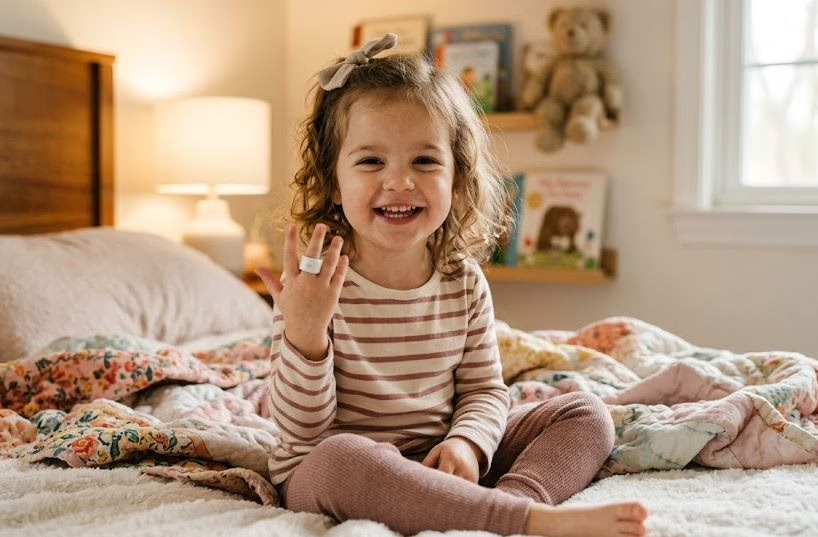
At our Mansfield office, the testing process is straightforward. A small ring-style sensor is worn comfortably on the finger during sleep. It is non-invasive, quiet, and does not require wires, belts, or anything attached to your head or chest. While you sleep, it continuously captures multiple streams of physiological data — including oxygen saturation levels, heart rate variability, breathing patterns, and movement. That data is then securely uploaded and reviewed.
Importantly, I want to be clear about something: the information gathered from sleep testing is for informational purposes. Dr. Jung does not analyze or interpret the raw data herself. Every study we facilitate is reviewed and interpreted exclusively by qualified professionals, with further recommendations made if necessary. Our role is to help identify that a conversation about your sleep health might be worth having — and to make that process as easy and accessible as possible.
We typically conduct sleep testing over two consecutive nights. There is good reason for that. Sleep quality and breathing patterns can vary from one night to the next, and a single recording may not capture the full picture of what is happening physiologically. Multi-night testing provides a more complete, more accurate view.
Why Would a Dentist Be Offering This?
This is the question I hear most often — and honestly, it is a fair one.
Here is what I tell patients: your teeth, jaw, tongue, and airway are not separate systems. They are deeply connected. The structure of your mouth — the width of your palate, the position of your jaw, the size and tone of your tonsils and soft tissues — directly influences how air moves in and out of your body while you sleep.
That means a dentist who is trained in airway health is not stepping outside the bounds of dentistry. They are looking at the full function of the oral-facial complex, which includes breathing. It is whole-body thinking applied to a dental setting.
I have been practicing with this perspective for years, and it shapes everything we do here at Central Park Dental & Orthodontics. We were recognized among D Magazine’s Best Dentists — an honor I am proud of — but more importantly, it reflects the kind of care I want patients in Mansfield, Arlington, Kennedale, Midlothian, and everywhere in between to have access to: care that actually looks at the whole person.
I first developed an interest in the connection between oral health and systemic wellbeing early in my education. Before dental school, I earned a degree in Child Psychology and Education — and that foundation shaped how I think about health. The way a child sleeps, breathes, and develops is not separate from how they think, behave, and grow. The two are interwoven. That same principle guides how I approach care for patients of all ages.
The Truth About Sleep-Disordered Breathing — And Why It Stays Hidden
Here is what I see regularly in my practice, and what concerns me about how this topic is typically addressed.
The most common symptoms of sleep-disordered breathing are not the ones most people think of. Everyone pictures someone who snores loudly and wakes up gasping. And yes, that happens. But many people — especially children — present very differently.
In adults, sleep disruptions can show up as unexplained fatigue, difficulty concentrating, mood changes, morning headaches, or waking up feeling like sleep never really happened. Many patients have visited multiple doctors for these symptoms and been told everything looks normal.
In children, the picture can look even less like “a sleep problem.” Kids with disrupted nighttime breathing often show up as hyperactive, easily frustrated, or struggling to focus at school. Excessive daytime sleepiness is actually not a common presentation in children with sleep-disordered breathing — which is one of the reasons it gets missed so often. Mouth breathing, restless sleep, waking up with a dry mouth, and behavioral changes are frequently the real signals.
I have had parents bring in children as young as three years old because something just felt off — and they were right to trust that instinct. The earlier we can gather objective information about how a child is sleeping and breathing, the earlier we can bring the right professionals into the conversation.
What the Sensor Actually Measures — In Plain Language
Let me walk through what happens during the testing process without getting into clinical jargon, because I think understanding this helps patients feel more comfortable with it.
When you wear the ring sensor during sleep, it measures several things simultaneously. It tracks your oxygen saturation — how much oxygen is circulating in your blood — throughout the night. It monitors your pulse rate and how it varies from breath to breath, which tells us a great deal about how your autonomic nervous system is managing sleep. It also captures a breathing signal derived from changes in blood flow, and records movement through actigraphy.
These streams of data are analyzed together using specialized medical software — designed specifically for sleep and airway evaluation — that generates a comprehensive picture of your sleep quality, sleep stages, and any patterns that may indicate breathing disruptions. The system uses algorithms that have been clinically validated and are FDA-cleared as a medical device.
What comes back is not just a single number. It is a detailed view of how your body moved through different sleep states, how stable or fragmented your sleep was, and whether there are signs of disrupted breathing that warrant further evaluation.
As I mentioned, this output is then reviewed and interpreted by qualified professionals. We do not use it to diagnose anything ourselves. But it gives us — and the specialists we work with — objective data to ground the clinical conversation in something real.
Specialized Imaging and Advanced Diagnostics at Central Park Dental
Home sleep testing does not exist in isolation in our office. It is part of a broader commitment to advanced, whole-body diagnostic thinking.
We use 3D CBCT imaging, which allows us to see the airway in three dimensions — visualizing the spaces through which air travels in ways a standard X-ray simply cannot capture. We use laser dentistry. And we use specialized medical imaging visualization and analysis software specifically for sleep and airway evaluation — tools that go well beyond what a typical dental office offers.
This layered diagnostic approach allows us to see patterns and structural considerations that might otherwise be invisible. And it allows us to have much more meaningful conversations with the physicians, pulmonologists, sleep medicine specialists, and ENTs who are part of our patients’ broader care teams.
Our collaborative care model is something I believe in deeply. Dentistry does not exist in a silo. A comprehensive view of your health requires multiple perspectives — and we are committed to working alongside the other providers in your life, not around them.
The Three Pillars of Well-Being — And Why Sleep Is Central to All Three
My philosophy of care is organized around what I call The Three Pillars of Well-Being, and I want to share them here because sleep sits at the intersection of all three.
Structural Balance — this encompasses the alignment of your body and the structural integrity of your oral complex, including precise tooth positioning for optimal function. How your jaw sits, how your airway is shaped, and how your tongue rests all influence breathing during sleep.
Chemical Balance in the Body — when sleep is disrupted, the body’s internal chemistry shifts. Chronic oxygen deprivation at night, disrupted sleep stages, and autonomic stress responses all affect the body’s ability to regulate hormones, manage inflammation, and maintain the internal environment necessary for healing and recovery.
Emotional, Mental, and Spiritual Balance — sleep is where the brain consolidates memory, processes the experiences of the day, and restores emotional resilience. When sleep is fragmented or shallow, that restoration does not happen fully. The connection between poor sleep and anxiety, mood disruption, and cognitive fog is well established.
When one pillar is unstable, the others feel it. That is why a conversation about sleep is never really just a conversation about sleep.
Patient Success Story
Kemi, a patient who came to us with airway concerns, summed it up simply and beautifully in her review: “Dr. Jung is patient and friendly. She really knows her stuff. I’m breathing much better with the airway and tonsil reduction treatment!”
And then there is Creed, who shared that after their experience with us, the best part was “finally sleeping better.”
These are not dramatic testimonials. They are quiet, real shifts in daily life — the kind that happen when breathing improves and sleep finally does what sleep is supposed to do.
Sarah, who drove from the San Antonio area specifically to see Dr. Jung, shared that she had researched specialists across the country before finding our office. What moved her most was that “Dr. Jung took more time than any doctor ever has to understand the complete picture of my health.” She said she felt “inspired leaving Dr. Jung’s office and hopeful that relief and options were available.”
That is the experience we work to create for every patient who walks through our doors — whether they are coming from Mansfield, Arlington, Alvarado, Irving, or from out of state.
Frequently Asked Questions About Home Sleep Testing
What is home sleep testing, and how is it different from an in-lab sleep study?
Home sleep testing allows you to collect physiological data during sleep in your own home, rather than in a clinical facility. You wear a small, comfortable sensor during sleep, and the data is uploaded and reviewed by qualified professionals. An in-laboratory study involves more extensive monitoring in a medical setting and is typically recommended for more complex diagnostic situations. Home testing offers a lower-barrier starting point for gathering objective information about your sleep.
Who is home sleep testing appropriate for?
Both adults and children can participate in home sleep testing. The technology we use in our office is cleared for use in children as young as two years old, through adolescence and into adulthood. We have facilitated sleep testing for children as young as three, and for patients of all ages across the Mansfield, Fort Worth, and greater Dallas area — including patients who travel from out of state.
Does the sensor hurt or disturb sleep?
The sensor is a small ring worn on the finger. Most patients report that they quickly forget it is there. It does not require any adhesives, belts, or connections to other devices. The goal is to capture data as close to your natural sleep as possible, and the design supports that.
Will home sleep testing tell me if I have sleep apnea?
The test gathers objective data that is then reviewed and interpreted by qualified professionals — not by us. The results provide information about breathing patterns, oxygen levels, and sleep quality, which professionals then evaluate in the context of your symptoms and health history. We do not make diagnoses, and we do not make any claims about outcomes.
How many nights of testing does Dr. Jung typically recommend?
We typically recommend two nights of testing. Sleep quality and breathing patterns can vary significantly from night to night, and a two-night recording gives a more complete and accurate picture of what is actually happening during sleep.
Why would I do sleep testing at a dental office instead of through my doctor?
Because the airway is directly connected to your oral structure, airway-focused dental providers can offer a uniquely relevant starting point for this conversation. We look at how your jaw, tongue, palate, and soft tissues function — all of which influence breathing during sleep. We also work collaboratively with physicians and specialists, so the information gathered becomes part of a broader team conversation about your health. Patients from Mansfield, Burleson, Bedford, Haltom City, and surrounding communities — as well as those traveling from further away — find this integrated approach valuable.
Does Central Park Dental accept patients from outside of Mansfield?
Absolutely. We welcome patients from across the Dallas–Fort Worth area, including Arlington, Grand Prairie, South Arlington, Midlothian, Lillian, Britton, Sublett, Kennedale, and beyond. We also regularly see patients traveling from out of state who are looking for comprehensive, airway-centered dental care.
Can sleep testing through a dental office help my child?
Yes. Sleep-disordered breathing in children often goes unrecognized because it does not always look the way parents expect. Hyperactivity, difficulty concentrating, behavioral changes, mouth breathing, and restless sleep can all be signs that something is worth evaluating. The testing process is gentle and non-invasive, and our experience with young patients — including children as young as three — reflects our commitment to making this process accessible and comfortable for families.
If You’ve Been Wondering Whether This Is Worth Looking Into — It Probably Is
One thing I have noticed over the years is that the patients who benefit most from sleep evaluation are often the ones who waited the longest to ask.
They weren’t sure it was a “dental thing.” They thought they would need a referral first. They assumed a sleep study would be complicated and expensive. They were waiting until the fatigue got bad enough, or the snoring got loud enough, or a doctor finally pushed them toward it.
What I want you to know — wherever you are reading this from, whether you are in Mansfield or Arlington or Dallas or Fort Worth or driving down from out of state — is that you do not have to wait. A conversation costs nothing. And objective information about how your body is functioning during one-third of your life is genuinely valuable, regardless of what it shows.
We are not here to diagnose you or tell you what is wrong. We are here to be part of the conversation — to offer a thoughtful, whole-body perspective, advanced diagnostic tools, and a team that actually listens.
If something about your sleep has not felt right — for you or for your child — we would love to talk.
Central Park Dental & Orthodontics 1101 Alexis Ct #101, Mansfield, TX 76063 (817) 466-1200 www.centralparkdental.net
Related links:
Educational Disclaimer: This blog post is intended for general educational purposes only and does not constitute individualized medical or dental advice. The information shared here is not a substitute for a professional evaluation, diagnosis, or personalized treatment plan. Home sleep testing results are reviewed and interpreted exclusively by qualified professionals; Dr. Jung does not analyze or diagnose from this data. If you have concerns about your sleep health or your child’s breathing, please consult with a qualified healthcare provider. This content was developed by Dr. Jung with the support of AI writing tools for clarity and reach. All content is personally reviewed and edited by our team to ensure accuracy for general educational purposes.